Short answer: Snapchat does not publish a detailed mathematical formula for Friend Solar System rankings. What Snapchat does confirm is that Best Friends are the people you Snap and Chat with most, and the Solar System shows your position among those friends. Each planet represents a different position in that Best Friends list.
This means there is no reliable public formula such as “100 points for a Snap” or “three times more points for a video call.” Snapchat uses interaction data to provide features such as Best Friends, but it does not publicly disclose the exact weighting, score, decay period, or timing behind every ranking change.
My Personal Experience with the Snapchat Solar System Algorithm
A personal experiment can be interesting, but it cannot reveal Snapchat’s private ranking formula. Two people may use Snapchat in very different ways, and a change in their Best Friends list can have several possible explanations. For that reason, it is safer to separate what Snapchat documents from what users observe.
For example, imagine that you regularly Snap and Chat with one friend but start communicating much more frequently with another. Your Best Friends list can change over time because Snapchat says Best Friends are based on the people you Snap and Chat with most. That change can also affect which friends appear in your Friend Solar System.
The important lesson is that a long Snapstreak, an old friendship, or a large number of days as friends should not be treated as a guaranteed planet-ranking formula. Snapchat does not publish a rule saying that a particular streak length locks someone into Mercury or that a specific interaction count guarantees a planet.
So if your planet changes, the most accurate explanation is that your position in the relevant Best Friends relationship has changed or that the feature is displaying updated information. It is not evidence of a publicly documented score being crossed.
Read More: How Snapchat Top 8 Friends and Best Friends Lists Work
The Core of the Galaxy: How Snapchat Ranks Friends in 2026
Friend Solar System is built around Snapchat’s Best Friends concept. Snapchat says Best Friends are the friends you Snap and Chat with the most. You can have up to eight Best Friends, and the list is updated regularly.
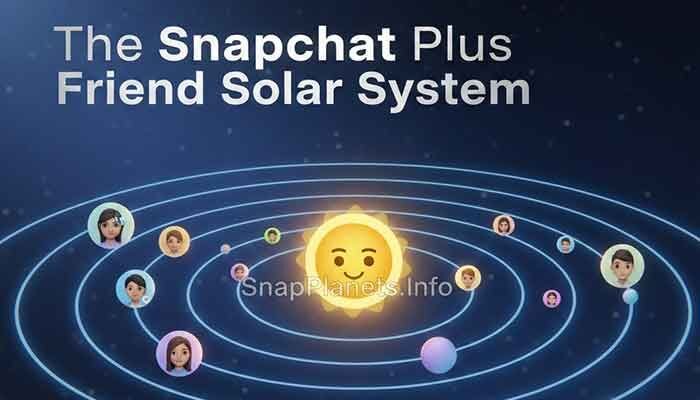
For Snapchat+ subscribers, the Friend Solar System turns those positions into planets. When you view the relevant Friendship Profile and tap the Best Friends badge, Snapchat can show which planet represents your position in that friend’s Solar System.
The Interaction Score: The “Secret Sauce”
There is an important distinction here: Snapchat uses interaction information to support Best Friends and related features, but it does not give users a public planet score or a complete weighting chart. Snapchat’s support information explains the outcome, not a numerical formula that users can calculate themselves.
- Snaps and Chats: Snapchat specifically describes Best Friends as the people you Snap and Chat with most.
- Recency: Snapchat support also describes Best Friends in terms of people you send 1:1 Snaps and Chats to most frequently and most recently. This helps explain why the list can change as your usage changes.
- Regular interaction: Best Friends are updated over time rather than permanently fixed when someone reaches a certain position.
- Other activity: Snapchat creates and uses metadata for several features, but it does not publish a public conversion table showing exactly how every action affects a planet.
Because the exact formula is not public, claims such as “one video call equals three times a text chat” or “watching a Story gives a fixed number of planet points” should be treated as speculation unless Snapchat explicitly documents them.
Breaking Down the 2026 Update: What Changed?
If your planet or Best Friends position looks different, it is tempting to assume Snapchat has introduced a secret algorithm update. However, Snapchat does not currently provide a public changelog that explains a specific 2026 change to the Friend Solar System ranking formula.
1. The Decay Factor
There is no official Snapchat statement establishing a fixed “decay factor” such as a 24-hour or 48-hour countdown for planet positions. Your Best Friends list can change as your Snapchat usage changes, but Snapchat does not say that a specific number of inactive hours automatically removes a friend from a particular planet.
This distinction matters because an old friendship or long streak does not guarantee a permanent Best Friends position. The list reflects how you use Snapchat over time, rather than serving as a lifetime record of friendship.
2. Multi-Media Weighting
Snapchat supports many ways to communicate, including Snaps, Chats, and calls. But Snapchat does not publish a public table assigning bonus points to AR Lenses, Snap Map activity, video calls, or other individual actions for Friend Solar System rankings.
So it is reasonable to say that your overall Snapchat activity can relate to how you use the platform, but it is not accurate to promise that one specific feature will move someone from Neptune to Mercury.
3. The “Mute” Impact
Muting Stories or notifications is a user-control feature. Snapchat does not publicly state that muting a friend automatically pushes that person to Uranus or Neptune, or that it adds a specific negative score to the Friend Solar System.
If you mute someone and later notice a ranking change, the two events should not automatically be treated as cause and effect. Other changes in your Snaps, Chats, and Best Friends list may explain the different position.
Decoding the Planets: What Your Position Means
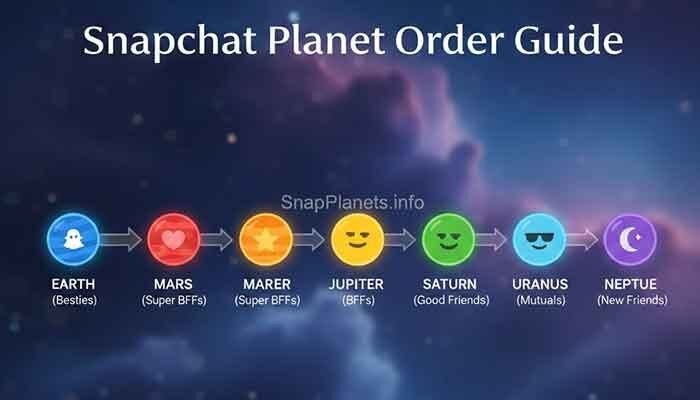
The planet itself is best understood as a position in a friend’s Best Friends list, not as a public friendship score. Snapchat’s official Friend Solar System guide maps the eight Best Friends positions to eight planets.
| Planet | Position | What It Represents |
|---|---|---|
| Mercury | #1 | First position in that friend’s Best Friends list |
| Venus | #2 | Second position |
| Earth | #3 | Third position |
| Mars | #4 | Fourth position |
| Jupiter | #5 | Fifth position |
| Saturn | #6 | Sixth position |
| Uranus | #7 | Seventh position |
| Neptune | #8 | Eighth position |
For example, seeing Mercury means the relevant friendship is represented as the first position in that person’s Best Friends list. Seeing Neptune means it is represented as the eighth position. The planet does not reveal an exact number of Snaps, Chats, points, or hours behind the ranking.
Deep Dive: How to Influence Your Orbit
If you want to become a higher-ranked Best Friend, there is no legitimate shortcut that guarantees a specific planet. The practical approach is simply to use Snapchat naturally with the person you communicate with most. Snapchat says Best Friends are based on the people you Snap and Chat with the most.
- Communicate naturally: Send Snaps and Chats when you genuinely have something to share instead of trying to manufacture activity.
- Keep conversations active: Regular communication can affect who appears among your Best Friends as your usage changes.
- Do not rely on streaks alone: A Snapstreak is not documented as a guarantee of a particular Solar System planet.
- Avoid supposed scoring hacks: There is no official public formula that lets you calculate how many interactions are needed to reach Mercury, Earth, or another planet.
Most importantly, do not treat a planet as a target that requires spammy behavior. Your Best Friends list is designed to reflect how you use Snapchat, and trying to force artificial activity can make the experience less useful.
FAQ: What the Internet is Asking
1. Can my friends see their rank in my Solar System?
Snapchat says a person can see whether they are among your Best Friends, but your complete Best Friends list is private. With Friend Solar System, a Snapchat+ subscriber can tap the Best Friends badge on a Friendship Profile to see their own planet position in the other person’s Solar System.
2. Why did my planet disappear?
A planet represents a position among the other person’s Best Friends. If you are no longer represented in that person’s relevant Best Friends positions, you may no longer see a planet for that friendship. Snapchat does not publish a rule saying that a planet disappears after one exact number of inactive days.
3. Does “My AI” count toward the Solar System?
Snapchat currently notes that if you Snap and Chat with My AI as much as your other Best Friends, you may see it on your Best Friends list. Because Friend Solar System represents positions in that list, this can affect what appears among your Best Friends-related features.
4. How often does the algorithm update?
Snapchat says Best Friends are updated regularly, but it does not publish a universal 24-hour or 48-hour schedule for every ranking change. Therefore, there is no official countdown that tells you exactly when a planet will move.
Martin’s Final Tip: Don’t Let the Planets Stress You Out
A planet is a Snapchat feature, not a complete measurement of a real friendship. Someone can be an important person in your life while appearing lower in a Snapchat Best Friends list simply because you communicate more frequently with other people on the app.
It is also worth remembering that Snapchat does not publish the complete ranking formula. If you see Mercury, Venus, or Neptune, use the planet as a simple way to understand the position Snapchat is showing rather than trying to convert it into an exact friendship score.
If you want to understand the wider Best Friends system, read our Snapchat Top 8 Friends guide. For more on Friend Solar System visibility, see our Snapchat Planets visibility guide.
You can also learn how rankings can change by reading our guides on resetting Snapchat Planets and group chats and planet rank. These guides explain what Snapchat documents and where the public information ends.