
Short answer: You cannot force Snapchat to move you from Neptune to Earth with a secret trick, fixed number of Snaps, or guaranteed seven-day method. Snapchat says Friend Solar System reflects your position among a friend’s Best Friends, while the exact ranking formula is not publicly documented.
If you want to improve your position naturally, focus on genuine one-to-one Snaps and Chats with that friend rather than trying to manufacture activity. Best Friends are the people you Snap and Chat with most, and Snapchat can update the list over time.
My Personal Experience with the Snapchat Orbit Hack
The original version of this section described a personal experiment that supposedly moved a Snapchat account from Neptune to Earth in six days. That result cannot be independently verified, and Snapchat does not publish a six-day method or a guaranteed planet-change schedule.
A better way to understand the feature is to treat the planets as positions in another person’s Best Friends list. If you appear as Neptune, you are in the eighth position of that friend’s Best Friends list. If you later appear as Earth, you have moved to the third position. The change reflects the ranking at that time; it is not a score that users can directly edit.
That distinction matters because many online guides describe hidden weights, exact interaction values, or shortcuts that Snapchat has never confirmed. You can change how you communicate with a friend, but you cannot manually assign yourself a planet or guarantee a specific result.
Read More: Snapchat Friend Emojis vs Planets
Understanding the “Orbit” Algorithm
Snapchat does not provide a public mathematical formula called a “Weighted Interaction Score” for Friend Solar System. What Snapchat does confirm is that Best Friends are the people you Snap and Chat with the most, and that Friend Solar System shows your position in that friend’s Best Friends list.
That means it is safer to focus on the documented relationship between communication and Best Friends rather than treating every Snapchat action as a known point value. Snapchat also says Best Friends can change over time, so your position is not permanently fixed.
The Hierarchy of Planets
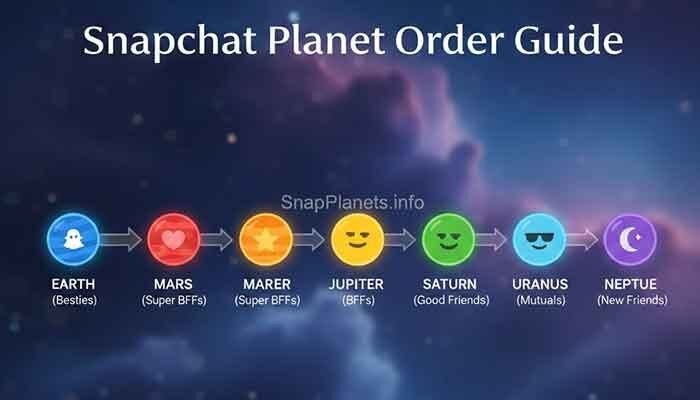
Friend Solar System uses eight planets to represent the eight positions in a friend’s Best Friends list. From closest to farthest, the order is:
- Mercury — 1st position
- Venus — 2nd position
- Earth — 3rd position
- Mars — 4th position
- Jupiter — 5th position
- Saturn — 6th position
- Uranus — 7th position
- Neptune — 8th position
What Actually Moves the Needle?
Snapchat does not publish exact points for individual actions such as lenses, stickers, replays, voice calls, Story replies, or Snap Map activity. So claims that one action is worth more than another should not be presented as confirmed ranking rules.
- Regular one-to-one communication: Snapchat says Best Friends are the people you Snap and Chat with the most.
- Reciprocal communication: A friendship ranking reflects your position in the other person’s Best Friends list, so their overall communication pattern matters too.
- Natural consistency: If you genuinely communicate more with a friend over time, your Best Friends position can change as Snapchat updates the list.
- Avoid artificial activity: Sending large numbers of empty or unwanted Snaps just to chase a planet is not a documented shortcut and can make the interaction less natural.
The 7-Day Speed Hack: From Neptune to Earth
There is no official seven-day speed hack that guarantees a move from Neptune to Earth. A seven-day plan can be useful only as a practical routine for improving genuine communication, not as a promise about how Snapchat’s ranking will respond.
Days 1-2: The Foundation (Volume & Variety)
Start by communicating normally instead of trying to maximize a hidden score. Send relevant Snaps, answer messages, and keep the conversation useful and natural. There is no official evidence that lenses or stickers receive special planet-ranking weight.
- Send a genuine Snap when you have something worth sharing.
- Reply to your friend’s messages instead of creating one-way activity.
- Use normal Snapchat features because they suit the conversation, not because you expect a secret multiplier.
Days 3-5: The Deep Dive (Engagement Multipliers)
During the middle of the week, continue the same approach. Longer conversations can be useful for the friendship, but Snapchat does not publish a formula saying that a two-minute call, replay, or video message moves you a certain number of places.
- Continue two-way Chats and Snaps when they happen naturally.
- Reply to Stories when you genuinely want to respond.
- Do not send content specifically designed to force a replay or increase an undocumented score.
- Do not assume that one special feature automatically carries more ranking value than another.
Days 6-7: The Closer (Consistency)
By the end of the week, your position may be different, unchanged, or even lower depending on how your communication compares with the other friendships in that person’s Best Friends list. There is no guaranteed Neptune-to-Earth deadline.
- Keep communicating naturally: A genuine conversation is more useful than sending repetitive Snaps for the sake of activity.
- Watch the overall relationship: Best Friends can change as your Snapchat usage changes.
- Give it time: A planet is a current position, not a permanent friendship score.
Interaction Value Comparison Table
Use this table to separate documented Snapchat information from claims that are often repeated online without official support.
| Activity | What Snapchat confirms | Planet-ranking claim |
|---|---|---|
| 1:1 Snaps | Best Friends are based on people you Snap and Chat with most. | No fixed point value published. |
| 1:1 Chats | Chats are part of how Snapchat describes Best Friends. | No exact multiplier published. |
| Story replies | You can reply to Stories. | No special planet weight published. |
| Snap replays | Some Snapchat+ features allow replays. | No fixed planet bonus published. |
| Voice/video calls | Friends can communicate through calls. | No official ranking value published. |
| Streaks | Streaks track continued Snapping between friends. | No guaranteed planet boost published. |
Why Isn’t My Rank Moving? (Troubleshooting)
If your planet has not changed, that does not necessarily mean Snapchat is broken. Your position is relative to the other friendships in that person’s Best Friends list, and Snapchat does not provide a public formula that lets you calculate exactly when a move should happen.
Here are the most useful things to check:
- The “One-Way” Trap: If you are sending much more activity than you receive, do not assume that increasing your own volume will guarantee a higher position.
- The “No Variety” Issue: There is no official rule saying blank Snaps or streak Snaps have a specific low score, so focus on genuine communication instead of trying to optimize a hidden value.
- The “Mercury” Wall: The top positions may be occupied by other people with whom that friend communicates more. You cannot manually remove someone from another person’s Best Friends list.
If the Solar System itself is missing, first check that you have Snapchat+, that Friend Solar System is enabled, and that the feature is available to you. Snapchat says Solar System is off by default for first-time subscribers and can be toggled in Snapchat+ feature management.
If the feature still does not appear, update Snapchat, restart the app, and check your connection. For persistent technical problems, use Snapchat’s in-app support and bug-reporting options.
FAQ: Your Snapchat Planet Questions Answered
Q: Does my Snapchat Score affect my planet rank?
A: Snapchat does not document a rule saying your overall Snapscore directly determines your Friend Solar System position. Friend Solar System represents your position in a specific friend’s Best Friends list.
Q: Can my friend see that I’m trying to move up their orbit?
A: Snapchat’s official Friend Solar System documentation explains the planet position but does not describe a notification that tells someone you are deliberately trying to improve your position. Avoid assuming that checking or pursuing a planet automatically sends a notification unless Snapchat explicitly says so.
Q: How often does the Solar System update?
A: Snapchat says Best Friends are updated regularly, but it does not publish a universal 24-to-48-hour recalculation schedule for Friend Solar System. A specific planet change therefore should not be tied to a guaranteed update window.
Q: Is there a way to “hide” my planet rank?
A: Snapchat lets first-time subscribers toggle Friend Solar System on or off through Snapchat+ feature management. Turning the feature off removes access to the Solar System feature rather than manually hiding one individual planet position.
Martin’s Final Tip: The “Quality over Quantity” Rule
The most reliable takeaway is simple: do not treat Snapchat Planets as a game with a published point system. Snapchat confirms that Friend Solar System maps your position to the eight Best Friends positions, but it does not give users a public formula for forcing a specific planet.
If you want to improve your position, communicate with the friend naturally and consistently. Send relevant Snaps, have real Chats, respond when you have something meaningful to say, and avoid flooding the account with repetitive activity just to chase Mercury or Earth.
For more context, see our Snapchat Interaction Score guide, Snapchat Solar System Algorithm guide, and Snapchat Best Friends vs Planets guide.
Remember that Neptune does not mean your friendship is bad, and Mercury does not provide a guaranteed measure of emotional closeness. The planets simply represent positions in a Best Friends list.


Pingback: Snapchat Yellow Heart vs Mercury: What’s the Difference? | Yellow Heart and Mercury Explained