Short answer: Snapchat does not publish a public interaction score, point system, or exact formula that explains how one friend reaches Mercury while another appears on Neptune. What Snapchat does confirm is that Best Friends are the people you Snap and Chat with the most, with up to eight positions represented by the Friend Solar System planets.
That distinction matters because many online guides present exact numbers for Snaps, Chats, streaks, Story views, or other actions as if they were official. Snapchat does not provide those fixed values. Your planet is better understood as a position in another person’s Best Friends list, not a publicly measurable score.
My Personal Experience with the Planet “Demotion”
There is no need to rely on a personal experiment to explain a Snapchat planet change. A planet can move because the Best Friends list changes as Snapchat activity changes, but Snapchat has not published enough detail to calculate exactly why one person moves ahead of another at a particular moment.
For example, someone can have a long Snapstreak with a friend and still see a different planet position. A streak shows that Snaps have been exchanged consistently, while the Friend Solar System represents a position in the Best Friends list. Snapchat does not say that a specific streak length guarantees a specific planet.
The same caution applies to claims about sending a certain number of Snaps, replying to a particular number of Stories, or chatting for a set amount of time. Those numbers may appear in community discussions, but they should not be presented as Snapchat’s official scoring formula.
Related guide: What Happens to Your Snapchat Planet Rank If You Are Blocked?
How Are Planets Calculated? (The Secret Sauce)
There is no publicly documented Snapchat formula that lets you calculate a planet score yourself. Snapchat’s official Friend Solar System guidance explains that Best Friends are the eight people you Snap and Chat with the most. Each planet then represents a different position in that Best Friends list.
It’s a Weighted System
It is tempting to assume that every Snapchat action has a published point value, but Snapchat has not provided such a table. You should therefore avoid treating one action as officially worth more than another unless Snapchat documents that specific rule.
- Snaps and Chats matter to Best Friends: Snapchat describes Best Friends as people you Snap and Chat with the most.
- No public point values: Snapchat does not publish an exact number of points for sending a Snap, receiving one, sending a Chat, or using a particular type of content.
- No guaranteed planet threshold: There is no official number of interactions that guarantees Mercury, Venus, or another planet.
- Positions can change: Because Best Friends can change, your planet position can also change over time.
The “Recency” Factor
Many guides claim that Snapchat uses a precise recency formula, such as giving recent interactions a fixed multiplier or resetting rankings after a certain number of hours. Snapchat does not publish those details. It is safer to say that Best Friends can change as your Snapchat activity changes rather than assigning an exact refresh schedule.
If you suddenly communicate more with one friend and less with another, their positions may change. However, the exact timing and mathematical reason for a specific change are not publicly documented.
Chat Weightage: Does Texting Actually Count?
Yes, Chats are relevant to the Best Friends definition because Snapchat explicitly describes Best Friends as people you Snap and Chat with the most. What Snapchat does not tell users is the exact mathematical weight assigned to different kinds of Chats.
That means it would be misleading to say that a voice note, text message, reaction, photo, or shared link automatically earns a specific number of planet points. These details are not published as a fixed Friend Solar System scoring chart.
What Counts in Chat:
- Direct Chats: Snapchat includes Chat activity in its description of Best Friends.
- Snaps: Snapchat also includes Snap activity when describing how Best Friends are determined.
- Other Chat features: Snapchat may offer different ways to communicate, but there is no public point chart showing the exact value of each one for Friend Solar System ranking.
- Frequency: More communication can be relevant to who appears among Best Friends, but there is no official threshold that guarantees a particular planet.
So, if you want to maintain a closer Snapchat friendship, normal two-way communication is more meaningful than trying to follow an unofficial “cheat code.” But do not expect a specific number of messages to produce a guaranteed planet.
Snapstreak vs. Rank: The Great Debate

Snapstreaks and Friend Solar System positions are related to Snapchat communication, but they are not the same feature. A Snapstreak tracks consecutive days of qualifying Snaps exchanged between friends. Friend Solar System shows your position in another person’s Best Friends list.
A long streak therefore does not automatically mean Mercury. Likewise, a shorter streak does not automatically mean Neptune. Snapchat does not publish a rule saying that a particular number of streak days equals a particular planet.
This is why claims such as “500 days equals Mercury” or “one Snap per day equals Saturn” should be treated as unofficial examples rather than facts. Planet positions represent Best Friends ranking, while streaks represent consecutive Snap activity.
The 8 Planets Explained (And What They Say About You)
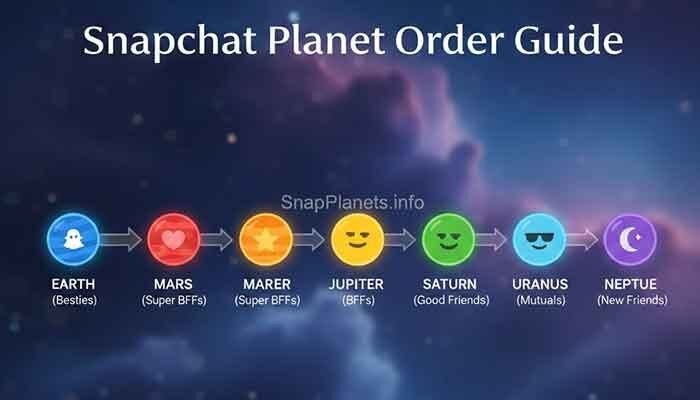
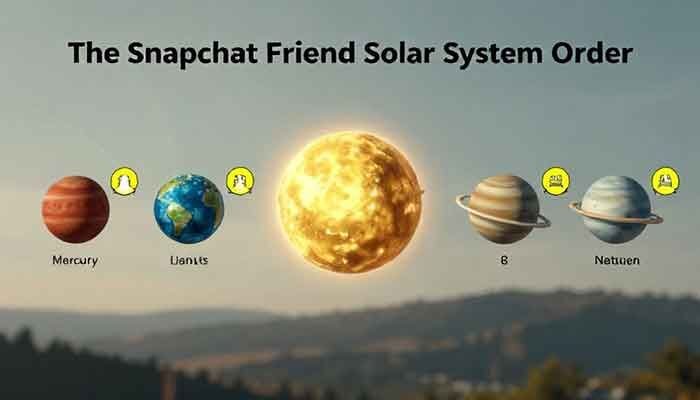
Snapchat’s Friend Solar System uses eight planets to represent positions in a person’s Best Friends list. Snapchat says Best Friends can include up to eight friends, and tapping the Best Friends badge can show which planet you are in that person’s Solar System.
1. Mercury (#1 Best Friend)
Mercury represents the first position in the Best Friends list. It means you currently hold the #1 position shown by Friend Solar System for that person. It does not prove anything about romantic feelings or the quality of the relationship outside Snapchat.
2. Venus (#2 Best Friend)
Venus represents the second position. You are still among the person’s eight Best Friends, but the planet indicates the second position rather than the first.
3. Earth (#3 Best Friend)
Earth represents the third position in the Best Friends list. It is a ranking position, not a label for how close the friendship is in real life.
4. Mars (#4 Best Friend)
Mars represents the fourth position. Being Mars means you are currently fourth among the up-to-eight Best Friends represented by the Solar System.
5. Jupiter, Saturn, Uranus, & Neptune
Jupiter, Saturn, Uranus, and Neptune represent positions five through eight. Neptune is the eighth position. These labels tell you where you appear in the Best Friends list; Snapchat does not define them as separate friendship levels with fixed emotional meanings.
| Planet | Position | Meaning |
|---|---|---|
| Mercury | 1st | First Best Friends position |
| Venus | 2nd | Second position |
| Earth | 3rd | Third position |
| Mars | 4th | Fourth position |
| Jupiter | 5th | Fifth position |
| Saturn | 6th | Sixth position |
| Uranus | 7th | Seventh position |
| Neptune | 8th | Eighth position |
Visual Roadmap: The Solar System Journey
Think of the Friend Solar System as a visual ranking tool rather than a hidden scorecard. Mercury is the first position and Neptune is the eighth. Moving between planets means your position in that person’s Best Friends list has changed.
For a broader explanation of Best Friends and the Top 8, see our Snapchat Top 8 Friends guide.
FAQ: Your Burning Questions Answered
Q: Can I see someone else’s full Solar System?
Snapchat’s documented feature lets you see which planet you are in another person’s Solar System when the Friend Solar System feature is available. It does not describe a tool that lets you inspect the complete ranking of all eight friends in that person’s system.
Q: Does my rank update instantly?
Snapchat does not publish a guaranteed 24-hour or 48-hour refresh schedule for Friend Solar System positions. If your planet changes, treat it as a change in your Best Friends position rather than assuming a specific timer or reset window.
Q: Why did I disappear from someone’s Solar System entirely?
If you no longer appear as one of that person’s Best Friends, your position may no longer be within the eight represented positions. Snapchat does not publish a single universal reason for every disappearance, so it is better not to assume an exact score, threshold, or automatic reset caused it.
Q: Does “Ghost Mode” or “Half-Swiping” affect my rank?
There is no official Friend Solar System scoring document that assigns a planet value to Ghost Mode or half-swiping. Avoid claims that these actions add or subtract a fixed number of points unless Snapchat specifically documents such a rule.
Martin’s Final Tip
The most useful way to read Snapchat Planets is simple: look at the planet as a position, not as a secret score. Mercury means first, Venus means second, and Neptune means eighth in the person’s Best Friends list.
If your position changes, there is no need to calculate imaginary points or follow a guaranteed “Mercury challenge.” Snapchat has not published the exact formula behind the ranking. Focus on normal communication and use the Solar System as a guide to your current Snapchat position.
For more troubleshooting, see How to Reset Snapchat Planets, Who Can See Your Snapchat Planets?, and our Snapchat Plus FAQ.